For decades, the trajectory of new home development in the United States followed a relatively predictable path: homes became larger as buyer expectations, amenities, and lifestyle programming expanded. Square footage often served as a proxy for value, and larger homes frequently commanded stronger pricing.
Today, however, the equation is changing.
Across multiple markets, developers and sales teams are beginning to observe a shift in how buyers evaluate the relationship between home size, pricing, and overall value. The market itself has not weakened. Demand remains strong in many regions. What is evolving is the structure of that demand — particularly how buyers respond to total purchase price.
Understanding this shift is becoming increasingly important for developers planning future product.
The Cost Equation Behind Today’s Pricing
One of the primary drivers of this shift is the rising cost structure associated with residential development.
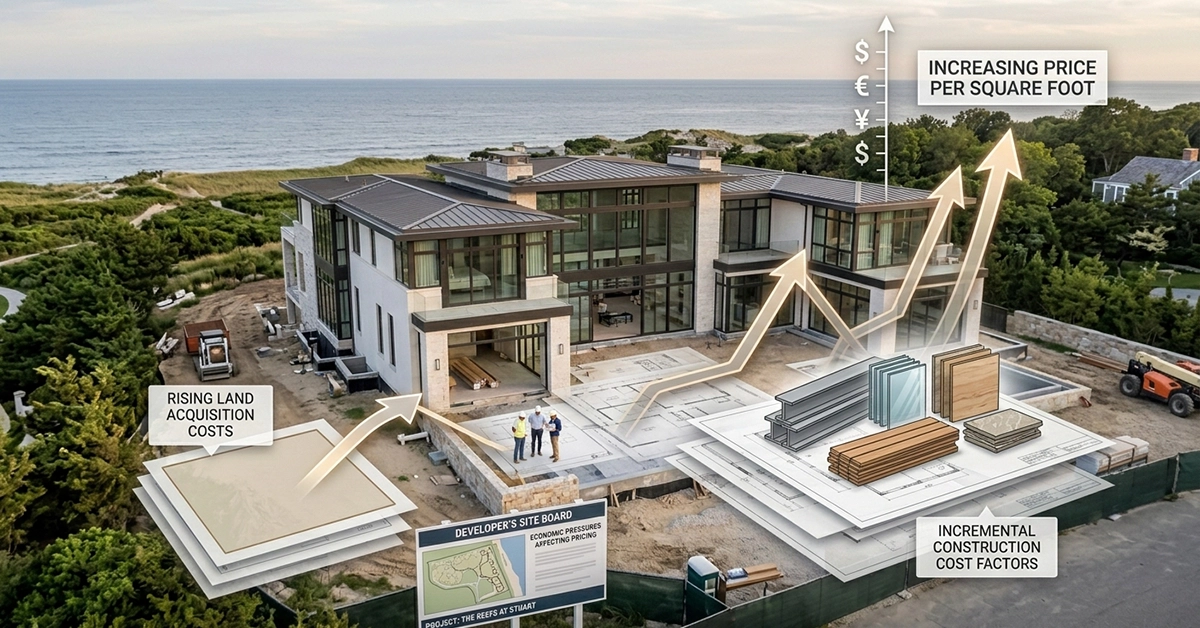
Land prices in desirable markets have continued to escalate, particularly in coastal, resort, and high-growth regions. At the same time, construction costs remain elevated due to labor shortages, material volatility, regulatory complexity, and extended development timelines.
Together, these factors are pushing the price per square foot of new homes higher. Even when developers manage projects efficiently, the structural cost base of development has changed.
The result is that larger homes — while still desirable in theory — increasingly produce total price points that exceed what the market will comfortably absorb.
This is where the conversation around home size begins to shift.

Escalating land and construction costs are pushing price per square foot higher, reshaping how developers and buyers evaluate home size.
When Total Price Becomes the Constraint
Buyers rarely purchase homes based solely on price per square foot. Their ultimate decision is shaped by the total purchase price and how that price aligns with their financial comfort and perceived value.
As overall pricing rises, the threshold at which buyers begin to hesitate is appearing earlier in the decision process. In some markets, the difference between a 3,500-square-foot home and a 4,500-square-foot home can translate into several hundred thousand dollars of additional cost.
At that point, the conversation is no longer about space. It becomes about affordability, value, and financial comfort.
This does not mean buyers are abandoning quality or lifestyle expectations. It simply means that size alone is no longer the most efficient path to delivering value within today’s pricing environment.
The Emerging Market Response
What is beginning to emerge in response is not a retreat from luxury, but a refinement of it.
Many buyers continue to prioritize well-designed kitchens, indoor-outdoor living, wellness spaces, and thoughtful architecture. What they may be less willing to pay for is excess square footage that does not meaningfully enhance how the home is experienced.
This is leading to increased interest in more efficient home designs — residences that maintain quality and lifestyle features while controlling overall size and, therefore, total purchase price.
Smaller homes, when intelligently designed, can deliver the same experiential value while allowing developers to maintain pricing within the range the market will support.
Why This Matters for Developers
For developers, the implications are strategic rather than tactical.
When land and construction costs push price per square foot higher, the natural instinct may be to increase home size to support pricing. In some markets and product categories, that strategy can work.
But when total price begins to exceed buyer tolerance, larger homes may slow absorption rather than accelerate it.
Developers who align product size with buyer affordability often find themselves better positioned to maintain sales velocity, particularly in markets where price escalation has outpaced income growth.
The opportunity is not simply building smaller homes. The opportunity lies in building smarter homes — residences that deliver lifestyle, design quality, and functionality within a price structure the market can sustain.
A Strategic Perspective from the Market
Laurie Andrews, President of Cotton & Company, notes that these shifts are becoming increasingly visible across active communities.
“Markets rarely disappear,” Andrews explains. “What changes is the structure of the opportunity. As pricing rises, the question developers must ask is not how large a home can be built, but what size home the market will comfortably support. When total price moves beyond that threshold, absorption naturally slows.”
Her observation reflects a pattern seen repeatedly across development cycles. Buyer demand remains present, but the product must align with the market’s evolving definition of value.
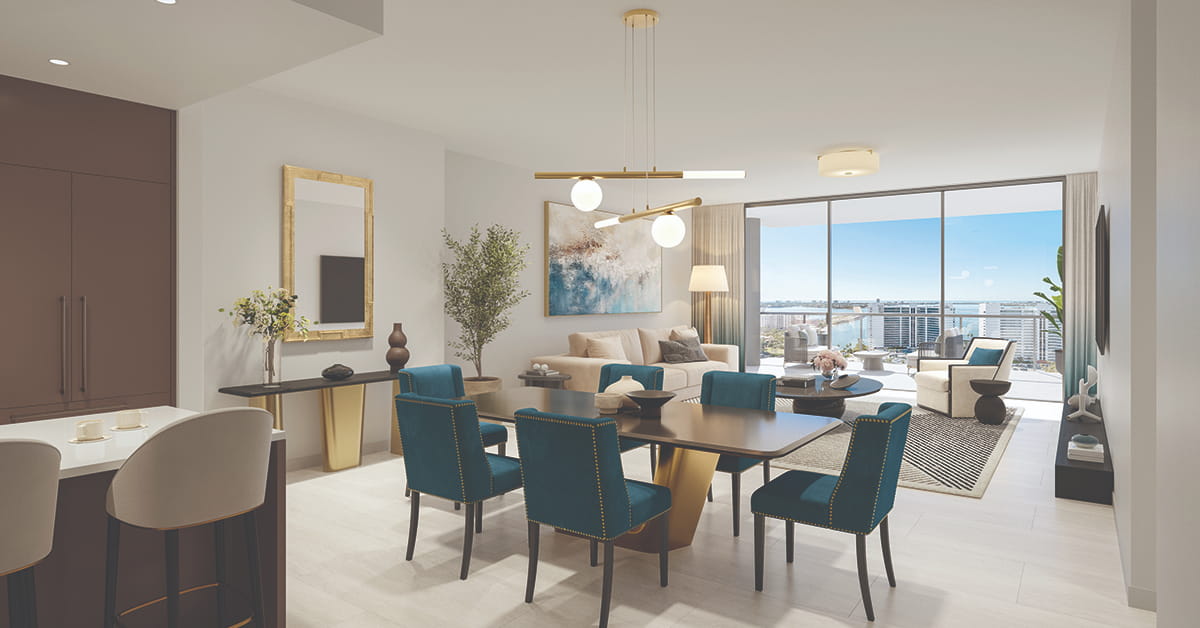
Kolter Urban’s 1000 Boulevard of the Arts in Sarasota reflects the growing emphasis on efficient design and thoughtful floor plans that deliver luxury living while managing total purchase price.
What Sales Teams Are Seeing
Sales professionals working directly with buyers are seeing similar dynamics.
According to Adam Kaufman of Premier Sotheby’s International Realty, buyer conversations increasingly focus on overall price and value rather than square footage alone.
“Buyers are still looking for quality and thoughtful design,” Kaufman notes. “But many are evaluating homes through the lens of total purchase price. When a home becomes significantly larger than what they need, the additional cost can become difficult to justify.”
These conversations often lead buyers to consider homes that are slightly smaller but designed with greater efficiency and lifestyle functionality.
The Market Is Evolving — Not Declining
Importantly, none of this suggests a weakening housing market.
Demand for well-located, thoughtfully designed homes remains strong. What is evolving is the relationship between size, price, and perceived value.
For developers, recognizing this shift early can create meaningful advantages in product planning and positioning.
Those who understand where the market is moving are often able to design homes that meet buyer expectations while maintaining pricing within a range that supports consistent sales velocity.
Moving Forward
Home size has long been one of the defining characteristics of residential development. Today, however, the conversation is expanding to include efficiency, design intelligence, and total price sensitivity.
Developers who respond thoughtfully to these changing dynamics will be better positioned to align their product with the realities of today’s market.
Cotton & Company works closely with developers to interpret buyer behavior, evaluate product positioning, and design marketing strategies that align with real market demand. For projects entering planning or repositioning phases, understanding how size, pricing, and buyer psychology interact has never been more important.
If you would like to evaluate how current buyer trends may influence product sizing, pricing, and positioning for your project, Cotton & Company welcomes the opportunity to discuss your development strategy.