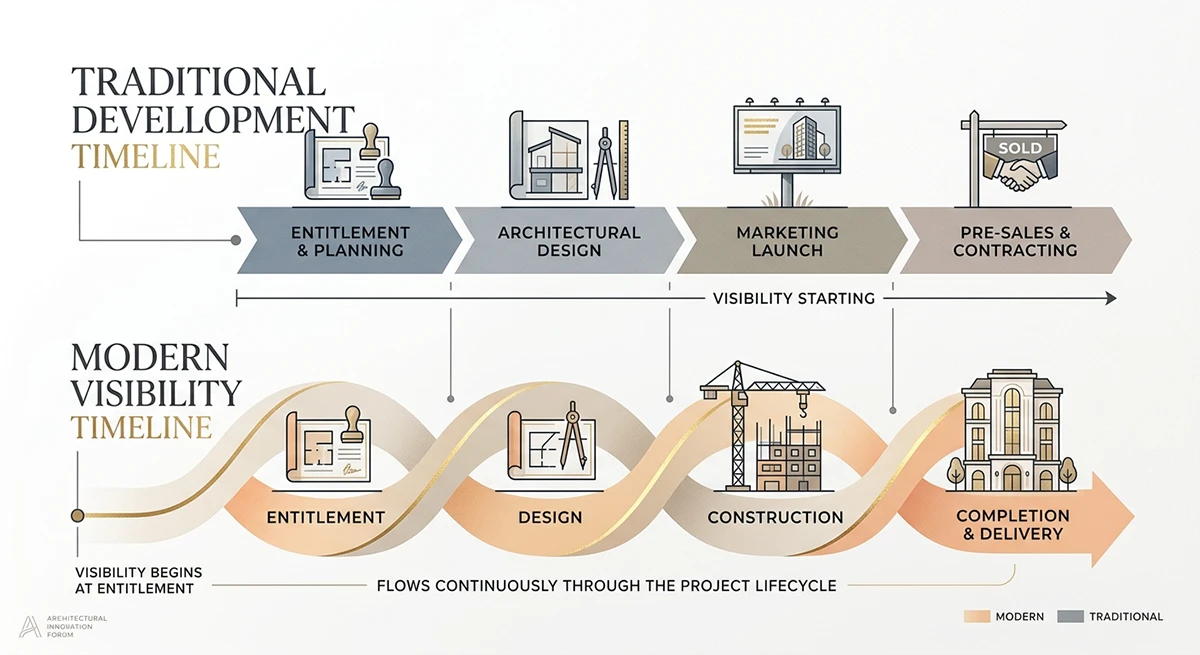
For decades, luxury real estate launches followed a defined sequence. Entitlements were secured, architectural plans advanced, brand and digital assets were developed, and lead generation followed. Marketing entered the process once a project was considered ready for sales. Today, that sequence leaves leverage on the table at the most critical stage of a project’s introduction.
In an AI-influenced environment, visibility is no longer something that develops after a project is ready. It is established at the point a project becomes viable—often at entitlement approvals—because the market is already forming opinions before traditional marketing has time to take hold. Early press can shape perception, but without a coordinated structure to support it, that narrative often fragments rather than compounds.

Early Visibility Now Shapes Buyer Confidence Before Market Entry
Buyers, brokers, and investors are no longer learning about the project through a controlled release of information narrated by the marketing team. AI-driven systems are interpreting and presenting information early, often before a formal launch sequence is traditionally developed.
A project lacking strategic guidance is encountered in fragments, assembled from multiple sources, and interpreted in real time. That interpretation becomes the foundation of how the project is understood—before a sales team has the opportunity to guide the conversation.
Shaping that narrative is no longer optional. It requires an integrated, upstream approach to visibility that aligns how the project is introduced with how it will ultimately be sold. This compresses the formation of buyer confidence. The project is either seen as credible and aligned, or it requires additional effort to establish trust and clarity.
When early visibility is structured with purpose, the project enters the market with alignment already in place. Buyers engage with a clearer understanding of the project, and the sales process advances with less friction. When it is not, the market defines the project instead. Inconsistent signals create hesitation, and confidence must be established under pressure rather than reinforced from the outset.
Performance Is Set Earlier Than Most Assume
In luxury development, visibility is often treated as a downstream marketing outcome. In practice, it functions as an early performance driver. How a project is understood at entry directly influences pricing strategy, absorption velocity, and capital exposure—long before those metrics are formally measured.
Projects that enter the market with aligned visibility establish stronger initial conditions. Buyer confidence forms earlier, and sales teams are able to advance conversations rather than recalibrate them. When visibility is delayed or inconsistently structured, the opposite occurs. Momentum slows, pricing becomes more reactive, and capital remains exposed longer than anticipated. Time is spent correcting perception rather than building on it.
These outcomes are often attributed to market conditions. More often, they are determined by how the project was understood at the outset.
The Gap Between Entitlement and Sales Launch
Between entitlement approvals and the formal launch of sales, there is a period that is often underutilized. Traditionally, this time has been treated as internal—focused on design completion, resource planning, sales center coordination, and preparation for a future introduction to the market. In practice, it is one of the most consequential phases of a project’s marketing lifecycle.
This is when a project begins to take shape publicly, whether intentionally or not. Information enters the market through fragmented, third-party interpretation. Without structure, those signals remain disconnected, yet they begin to form the foundation of how the project is interpreted in AI-driven environments.
The role of this phase is not to accelerate exposure, but to establish a clear and durable foundation for how the project will be understood. Narrative content must be introduced in a way that reflects how the project is meant to perform over time. The architect’s perspective, the rationale behind the plan, and the attributes that define the project’s place in the market are not supporting details. They are core signals.
Early visibility and controlled distribution of information allow those signals to take hold with consistency, building recognition and anticipation with consistency.
An Integrated Approach to Early-Stage Visibility
“The industry still treats visibility as something that happens at launch,” said Laurie Andrews, President of Cotton & Company. “In reality, it needs to begin at entitlement—when the project first becomes viable. From that point forward, the market is already forming a narrative, whether it’s structured intentionally or not.”
That distinction is where most developers are falling behind. Early-stage visibility is often reduced to earlier exposure—press releases, announcements, or isolated media moments. In practice, those are only individual inputs. What matters is how they connect, reinforce one another, and contribute to a broader understanding of the project.
This phase is defined by a window of attention. There is a natural curiosity around what is emerging in the market, particularly in competitive regions where buyers, brokers, and observers are looking to understand what is coming next.
PR alone is not the strategy. Visibility at this stage requires a layered approach—one that builds authority across multiple sources and formats. Long-form interviews, structured digital presence, and coordinated insights from the development, design, and sales teams all contribute to how the project is interpreted. These inputs, when aligned, begin to form a cohesive narrative that extends beyond a single announcement.
The objective is not simply to be first, but to ensure that what is encountered first is reinforced consistently. Cotton & Company approaches this phase with a level of precision shaped by experience. This is not achieved through surface-level application of AI, but through a depth of subject matter expertise that allows these opportunities to be recognized, structured, and applied within the development timeline.
In Buckhead Atlanta, Kolter Urban’s Elyse Buckhead reflects how this approach can take shape within a competitive and highly visible market.

Early Visibility Drives Strong Sales Performance in Atlanta
In one of Atlanta’s most competitive and closely watched submarkets, Kolter Urban’s Elyse Buckhead provides a current example of how early visibility and structured market entry can influence initial performance. Positioned adjacent to the St. Regis and entering a supply-constrained environment, the project began establishing its presence well before traditional sales momentum would typically be expected.
Rather than relying on a single point of introduction, the project was presented through a coordinated set of signals—digital presence, narrative development, and early market-facing content—allowing buyers and brokers to form a clearer understanding ahead of direct engagement.
With the Sales Gallery just opening in February, Elyse Buckhead is already approaching $60 million in initial sales and construction is now advancing. This outcome reflects a combination of factors, including project design, market timing, premier location, and an impressive developer track record. It also reflects how those attributes have been introduced and understood from the outset.
What This Means for Future Development Launches
Visibility and project marketing can no longer be treated as a phase that follows planning. It must be aligned with the earliest stages of development, when positioning, narrative, and market perception are first taking shape. Projects that proactively enhance visibility at this stage will benefit from greater exposure in AI search tools, resulting in a preferred project positioning, stronger buyer confidence, and more consistent absorption.
Projects that do not are forced to build both awareness and understanding at the same time. Momentum becomes less predictable, pricing becomes more reactive, and capital remains exposed longer than anticipated. This is not just a change in consumer search tools. It is a change in sequence.
Where Experience and Foresight Drive Performance
Most development teams are still adapting to how quickly AI visibility is influencing the sales landscape. The challenge is not simply understanding new tools. It is reducing the learning curve while the market continues to move forward. This requires more than technical execution. It requires a combination of deep industry experience, a clear understanding of digital visibility, and a forward-looking perspective on how consumer search behavior is evolving.
“Those disciplines rarely exist together,” said Andrews. “But when they do, it changes how a project performs from the outset. You’re able to recognize opportunities earlier, structure visibility with intention, and establish a position before the market defines it for you.”
That difference has a measurable impact. This is where experience and foresight converge. And for projects entering the market today, that convergence is will likely define early success.