
As the high season in Florida comes to a close, many developers are reviewing results that did not meet expectations for Q1 2026. Website traffic held relatively steady. Registrations declined. Absorption did not follow.
The default response has been to point to global uncertainty or increased competition. Those factors are real, but they do not explain performance on their own. Every developer should be asking a more direct question: what are we doing differently to reach our goals before year-end?
This is the point where most teams look to increase exposure, refine messaging, or adjust how budget is being deployed. The off-season is not simply a time to make adjustments. It is the time to evaluate what is actually happening within the sales program.
The issue is not about the creative quality of the website or branding. It is whether the current approach is aligned with where the market and technology are going.

Performance Gaps Are Being Misdiagnosed
When conversion performance softens, the instinct is to generate more leads to reach the sales objective. That assumption avoids a more important question. Why aren’t we getting more leads from the website traffic?
If a website is not converting interest into engagement, increasing traffic only increases frustration. It does not improve performance. Most teams recognize that something is off but cannot isolate it. The website appears complete. The messaging feels appropriate. The traditional tools are in place. The results suggest otherwise.
Developers are asking: what should we fix right now to improve performance before the next sales cycle? If there is uncertainty, that is the starting point, and it should be addressed now, not when the next sales cycle begins.
Buyer Behavior Has Already Shifted
The environment has changed. Search is no longer the only driver of discovery. Buyers are engaging with information differently, often through AI-influenced systems that shape what they see and how they evaluate options before ever reaching a website.

At the same time, buyers are more selective in how they engage. They are less inclined to register as the information that they are seeking is often provided for them through AI. In many cases, buyers are forming opinions before ever engaging directly. The risk is not just reduced registration, it is whether the information shaping those decisions is accurate, complete, or aligned with the project.
Websites built for a different cycle are now underperforming in both AI discovery and lead conversion.
Where Websites Are Breaking Down
This is not a design issue. It is a structural issue. Most real estate websites contain the right information, but it is not organized in a way that supports how buyers make decisions today. Questions are implied rather than answered directly. Content tells a story, but it often reads as sales-driven rather than authority-driven. Pages exist, but they do not work together as a system.
The result is a platform that looks complete but does not perform well with today’s AI tools. These gaps are difficult to identify internally. They are not obvious, and they are rarely flagged through surface-level review. They show up in performance.
The Off-Season Is the Ideal Window to Fix It
The slower months create a narrow opportunity to address these issues with discipline. It is the only time where adjustments can be made without the pressure of an active sales cycle. Waiting until the market returns in the fall removes that opportunity. At that point, the structure is fixed, and teams are forced to work around it.

A real estate website audit today is a structured evaluation of how a website supports buyer decision-making, AI visibility, and lead conversion. A meaningful evaluation goes well beyond a visual review. It requires an understanding of how the website functions across the full buyer journey and whether it aligns with current discovery behavior.
This includes how information is organized, how clearly questions are answered, how content connects across the site, and how easily both users and AI systems can interpret what is being presented.
At Cotton & Company, this evaluation is formalized through a structured audit framework developed through decades of work across active communities. The objective is not to critique individual elements, but to determine whether the system is aligned with how buyers evaluate and convert today, and where that alignment breaks down on AI visibility for developers.
What We’re Seeing Across the Market
Across multiple developments, a familiar pattern is emerging. Teams assume their digital foundation is sound because it was built correctly at the time. When evaluated against current conditions, gaps become clear, often in areas that were not previously considered critical.
In some cases, the most valuable outcome is not the identification of known issues, but the discovery of problems that were not visible internally.
From the sales perspective, the connection between structure and performance is becoming more evident. Projects that have invested in foundational clarity are outperforming those that continue to rely on incremental marketing adjustments.
This is not a reflection of effort. It is a reflection of alignment.
What developers should fix this off-season: the most common issues identified in high-performing audits are straightforward.
-
Website structure must align with buyer decision stages.
-
Key questions must be answered directly, not implied.
-
Content must support both human understanding and AI interpretation.
-
Conversion pathways must match modern buyer behavior.
Experience Must Lead the Technology
It is important to separate the role of technology from the role of real estate marketing experience. AI is influencing how buyers discover and evaluate projects. It is accelerating the process, but it is not replacing strategy. The real advantage comes from how experience is applied within this environment.
Laurie Andrews, President of Cotton & Company, explains, “Over the past year, we’ve built AI-powered resource tools that integrate more than 40 years of real estate experience with today’s technology. This is not about generating content faster. It’s about understanding how information is interpreted, how credibility is established, and how visibility is earned within these systems. If our clients are not visible within AI-driven environments, they will not be visible to the consumer.”
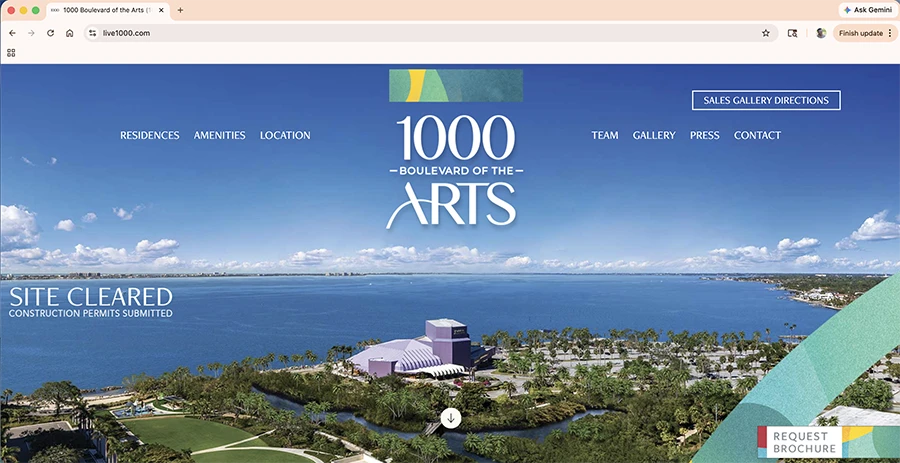
Technology supports that process. It does not define it.
A comprehensive evaluation is required and a fresh perspective is valuable. It requires an honest assessment of whether the website is functioning as a sales tool or simply presenting information. If that answer is unclear, it is worth examining more closely.
The off-season will pass quickly. The market will return, and with it, increased competition and renewed buyer activity. The projects that perform best will be those that used this period to address structural issues before that pressure returns.
For developers evaluating their position, the next step is straightforward. Review the website with a critical lens. Determine whether it is aligned with how buyers discover and make decisions today. If there is uncertainty, that is the starting point.
Visit Cotton & Company to understand the scope of work, the types of projects supported, and how digital infrastructure is being approached across active developments. From there, determine whether a structured audit of your website would provide clarity on what is working, what is not, and what needs to be addressed before the next sales cycle begins.