Published by Steve Marcinuk, Key Crew Journal
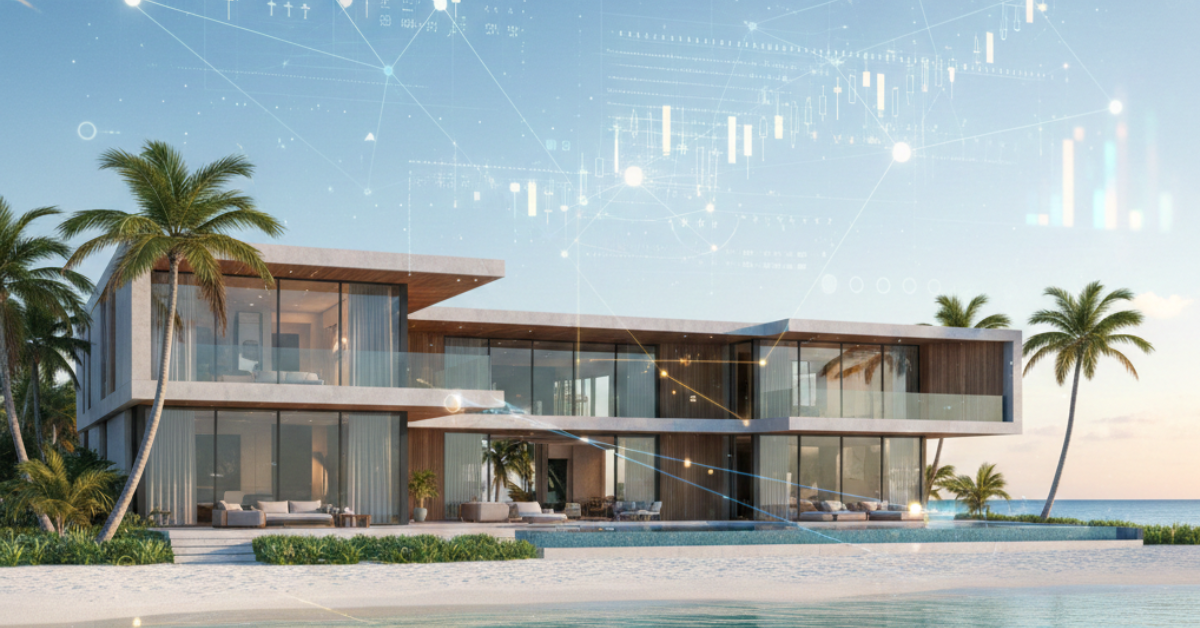
Florida’s luxury residential development market is undergoing rapid change as artificial intelligence (AI) alters how buyers search for, evaluate, and select properties. This shift comes as the market moves past the pandemic-driven buying surge into a more stable, measured pace, forcing developers and marketers to adapt quickly or risk losing ground.
Laurie Andrews, President of Cotton & Company, a real estate marketing firm specializing in luxury developments across Florida, has seen these changes unfold firsthand. With over four decades in the industry, her firm works with new high-rise towers on both coasts of Florida as well as established country club communities that emerged during the development booms of the 1990s and early 2000s.
AI Accelerates Change
The most significant force currently shaping luxury real estate development is not construction cost or economic uncertainty, but the rapid adoption of AI-driven search and marketing tools by high-end buyers. According to Andrews, “Marketing is evolving very, very fast in this world, and not everyone in the industry realizes how quickly it’s advancing.”
Luxury buyers, she notes, are typically early adopters of technology. Many follow business and tech trends in publications such as Forbes and The Wall Street Journal and are eager to use new tools when researching potential purchases. “Luxury people adopt technology sooner. They’re reading about it, leaning into what this is all about, and using it to research new properties,” Andrews says.
The impact goes beyond standard search engine optimization. As Google and other platforms introduce more advanced AI agents, developers who have not optimized their digital presence for AI-driven discovery could see their properties overlooked. Andrews cautions that once AI search becomes the norm, “If you’re not positioned correctly with your AI visibility, it’s going to be a lot of catch-up work to get there.”
Market Conditions
Despite headlines touting Florida’s “red hot” luxury market, the reality is more complex. The ultra-luxury segment, properties priced above $4 million, remains strong, with branded residences setting the pace. For example, the Ritz Carlton Residences in Sarasota Bay recorded over $25 million in sales in January alone.
However, the broader $2-4 million luxury tier is seeing increased competition as more projects launch simultaneously. Andrews observes, “There are more places and more choices, so sales are being spread out a little more.” While overall sales volume has not dropped sharply, the market is no longer absorbing new inventory at the breakneck speed seen in 2020 and 2021.
Developer sentiment reflects this adjustment. Most remain optimistic about long-term fundamentals but are recalibrating their expectations. Instead of rapid sellouts, developers are settling into what Andrews calls “a new normal,” steady but slower absorption. “They’re confident and seeing success, but they’re being very smart about their timelines,” she says.
Ultra-Luxury Buyers Prioritize Service and Time
One of the clearest trends in the ultra-luxury segment is the growing importance of service and time savings. Wealthy buyers increasingly value turnkey experiences over traditional amenities. “The truest luxury in life is time. There’s one thing money can’t buy, and that’s more time,” Andrews says. For these buyers, properties that offer full-service living, such as branded residences with hotel-style services, command premium pricing and sell faster than comparable unbranded developments.
Strategic Positioning in a Crowded Market
With more developments launching in proximity, developers must carefully position their projects to stand out. Cotton & Company’s work in Sarasota illustrates this challenge. The firm manages marketing for both the ultra-luxury Ritz Carlton Residences and the neighboring 1000 Boulevard of the Arts, requiring distinct strategies for each.
The Ritz-Carlton targets global entrepreneurs and high-end travelers seeking exclusivity and brand prestige. In contrast, 1000 Boulevard of the Arts appeals to buyers seeking vibrant, park-side living with access to cultural amenities. “These properties must be very different but complementary, because they’re side by side, and you want them to validate the decision for both purchasers,” Andrews explains.
Construction Timing
In today’s market, the ability to start construction without waiting for high pre-sales thresholds is a major differentiator. Buyers are more likely to commit to projects with visible progress and clear delivery timelines. “The players who can start construction and have a definitive timeline for delivery are going to capture a greater share of the market, because buyers can have confidence that delivery will occur,” Andrews says.
She points to The Island at West Bay in Naples, where developer Kolter Urban began construction well before reaching traditional pre-sale goals. As the building rises—already at the eighth floor—buyer interest and confidence have increased, translating into stronger sales momentum.
Economic Outlook
Looking ahead, Andrews is optimistic about the long-term fundamentals of Florida’s luxury market. She sees the potential for lower interest rates to unlock more transactions, as buyers who need to sell existing homes before purchasing new ones find it easier to move. “In order to buy something new, many people have to sell what they’re in, and we need to see the general market overall gain energy,” she notes.
Cotton & Company is also monitoring opportunities beyond Florida, particularly in the Caribbean and the Bahamas, where rising Florida prices may prompt luxury buyers to consider alternatives. The firm is involved in a project on Treasure Cay in the Abacos, part of the region’s rebuilding after Hurricane Dorian.
Changing Buyer Expectations
Today’s luxury buyers approach major purchases differently than in previous cycles. Rather than responding to high-pressure sales tactics, ultra-luxury buyers want to discover properties on their own terms, envision how they will live in them, and assess how a home will make them feel. Andrews notes, “They want to discover it, understand it, and envision how they’re going to live within it.”
As a result, developers and marketers must balance several key factors: location, amenities, lifestyle, product design, and, crucially, timing. Buyers now weigh not only current value but also the future trajectory of a neighborhood, especially during a project’s construction phase.
Article Published by Steve Marcinuk, Key Crew Journal