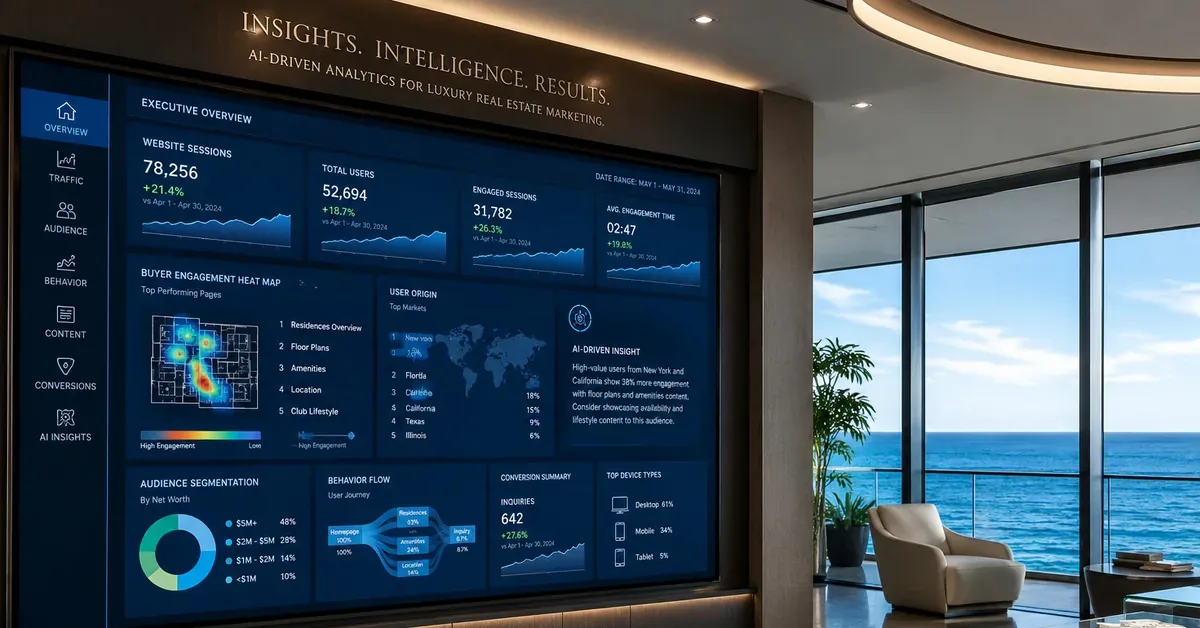
Website analytics have always required interpretation, but the margin for misunderstanding is widening. As artificial intelligence changes how consumers search, research, and interact online, familiar metrics no longer tell the full story. Average time on site, page views, session duration, and registration volume still matter, but without context, they can easily lead teams toward the wrong conclusions.
For luxury real estate developers, this shift creates a more complex measurement environment. The question is no longer whether website traffic is increasing or whether visitors are spending enough time online. The more important question is whether the right prospects are finding the right information, engaging with it meaningfully, and moving closer to a qualified inquiry.
Why Traditional Website Analytics Are Failing Luxury Real Estate
Broad website averages can be misleading in luxury real estate. If analytics show that visitors are spending less time on a site, the instinct may be to simplify the experience, shorten content, or reduce detail. On the surface, that appears logical. In practice, it can undermine the sales process.
Luxury buyers rarely make impulsive decisions. Before contacting a sales team, they often conduct extensive online research. They compare location, lifestyle, service standards, amenities, ownership structures, long-term value, and cultural fit. Increasingly, that research is also influenced by AI-powered search tools that summarize, interpret, and surface information differently than traditional search engines.
This means luxury websites must serve three audiences simultaneously: the consumer, Google, and the AI systems helping consumers evaluate their options. Averages alone cannot capture that complexity. When AI traffic, casual visitors, early-stage researchers, and highly qualified prospects are blended into one benchmark, the behavior of the most valuable audience becomes diluted. A decline in average engagement may not indicate weaker buyer interest at all. Without segmentation and interpretation, leadership risks reacting to the wrong signal.

Why Luxury Buyer Behavior Requires a Different Benchmark
Luxury real estate has never been a volume business. In many cases, fewer highly qualified leads are far more valuable than larger quantities of low-intent registrations.
Traditional marketing benchmarks often prioritize traffic growth and conversion volume. Luxury real estate requires a different lens. The objective is not to reach everyone. The objective is to reach the right audience with a compelling story, meaningful substance, and enough confidence-building information to support action.
“In the real estate development business, analytics are only meaningful when they are interpreted against the sales objective,” said Laurie Andrews, President of Cotton & Company. “Through years of analyzing the online behavior of qualified prospects over multiple projects, we have garnered a deep understanding of the buyer’s digital journey.”
Qualified buyers often move through a longer research cycle before making themselves known. They may revisit the website repeatedly, compare floor plans, evaluate club structures, study amenities, review pricing strategy, or assess whether the opportunity aligns with their broader lifestyle goals. That behavior should not be interpreted the same way as casual website traffic.
How AI Is Changing Luxury Real Estate Analytics
Luxury buyers are intelligent, discerning, and highly capable of identifying opportunity when it is presented clearly. They do not need websites to oversell. They need clarity, confidence, and access to meaningful information.
A luxury real estate website should not be designed around the assumption that every visitor wants less content because the average session duration appears lower. It should be designed around the understanding that qualified buyers often require deeper information, stronger storytelling, and more intentional sequencing. This is where analytics interpretation becomes critical.
A decline in average time on site does not automatically mean visitors are disengaged. It may indicate changing traffic composition. It may reflect the influence of AI systems interacting differently with website content. It may suggest that broader campaigns are increasing awareness beyond the highest-intent audience. Or it may reveal a legitimate content issue. The data can identify the question. Judgment is required to determine the answer.
Cotton & Company’s approach has always centered on that distinction. Marketing exists to support sales objectives, not generate activity for its own sake. Clicks, impressions, and raw traffic volume may provide useful context, but they are not the finish line. In luxury real estate, the more meaningful measure is whether marketing is producing qualified opportunity.

What Orchid Island Reveals About Lead Quality
The Orchid Island Club provides a useful example of why luxury analytics need a different lens. The community is highly selective, with approximately 350 homes and a country club membership exceeding $250,000. For a property with that profile, generating hundreds of unqualified leads is not the objective. The strategy is designed to identify prospects with the financial capacity, lifestyle alignment, and genuine interest necessary to engage meaningfully.
Through monthly reporting, Cotton & Company’s analysis revealed that buyers with homes valued above $4 million represented only three online registrations, approximately 4 percent of the total lead volume. Yet those same prospects averaged 21.6 page visits and returned to the website multiple times throughout their evaluation process.
Lower-value home segments generated greater registration volume, but they did not demonstrate the same depth of engagement. The insight did not lead to reducing website content. It led to strengthening the online experience with more meaningful information and better resources for qualified buyers.
“Cotton’s digital focus is not simply about producing more traffic,” said Amanda Hope of Orchid Island. “They have efficiently targeted an audience that aligns with our community mindset. It is about reaching a highly affluent audience seeking a more secluded coastal club address, and then giving that audience confidence to take the next step.”
Why Website Decisions Should Not Be Made from Blended Metrics
One of the greatest risks in analytics interpretation is making structural website decisions based on blended averages. If average engagement appears low, teams may conclude that visitors want shorter pages, less detail, or a simplified experience. In luxury real estate, that assumption can work against the sales objective.
Qualified buyers are often the very audience seeking deeper information. They want to understand the ownership experience, community culture, club structure, lifestyle positioning, location advantages, and long-term value proposition. Removing that information may create a more efficient experience for casual traffic while simultaneously weakening the experience for serious buyers.
Additional insights from CRM systems, social engagement patterns, audience profiling, and first-party data often reveal a more complete picture of buyer intent than website averages alone. Historic benchmarks also require reevaluation. AI systems are changing how information is discovered, summarized, and consumed. Buyer research patterns are evolving. Traffic composition is shifting. Traditional benchmarks cannot remain static while the digital environment fundamentally changes around them.

Cotton Insights and the Future of Real Estate Intelligence
To address this evolving landscape, Cotton & Company is developing the Cotton Insights Engine, an intelligence framework designed specifically for luxury real estate analytics.
The platform will aggregate performance data across dozens of real estate-focused clients while combining AI-supported interpretation with senior-level strategic oversight. The objective is not automation for its own sake. The objective is faster pattern recognition, stronger interpretation, and more informed decision-making.
By analyzing trends across multiple luxury communities, resort properties, private clubs, and new development programs, Cotton Insights is designed to identify shifts in buyer behavior, emerging audience trends, evolving engagement patterns, and market opportunities that may not be visible within a single project dashboard alone.
Why First-Party Data Matters in Luxury Real Estate Marketing
First-party intelligence has become increasingly valuable in luxury real estate marketing. Cotton & Company’s position inside the development environment every day, across multiple luxury market segments, provides a broader and more relevant data foundation than historic marketing benchmarks alone.
When deep industry experience is paired with AI-supported analysis, data becomes more than reporting. It becomes strategic intelligence.
That intelligence can help development teams better understand timing, budget allocation, content strategy, buyer sentiment, and sales absorption trends with greater confidence and clarity.
Cotton & Company’s approach has always been experience-driven and data-informed. Today, AI serves as an intelligence amplifier rather than a replacement for human judgment. Cotton Insights is being developed around that core principle.
How AI Search Is Changing Luxury Real Estate Websites
AI search is changing how luxury real estate content is discovered, summarized, and evaluated. Buyers may no longer arrive at a website through a traditional keyword search alone. They may first encounter a community, residence, or development through an AI-generated summary, conversational search result, or comparison-style response that draws from available online content.
That shift makes website depth more important, not less important. AI systems need clear, credible, and specific information to understand what a property offers, who it serves, where it is located, and why it is distinct. A luxury real estate website with thin or overly general content may be easier to skim, but it gives both buyers and AI systems less substance to work with.
For developers, this changes the role of the website. It must still inspire the buyer, but it must also provide enough structured information to support discovery, interpretation, and confidence. Location details, lifestyle positioning, amenity descriptions, ownership information, FAQs, editorial content, and market context all help strengthen the digital foundation.
AI search also reinforces the importance of authority. First-party insight, original market perspective, project-specific expertise, and clear answers to buyer questions make a website more useful to both consumers and search systems. In luxury real estate, where decisions are complex and highly personal, the strongest websites will be those that combine emotional appeal with meaningful, well-organized information.
The Future of AI in Luxury Real Estate Marketing
The future of luxury real estate marketing will depend on better intelligence, not broader assumptions. AI will continue to reshape how buyers research properties and how websites are accessed, summarized, and measured. Analytics platforms will continue to evolve. Traditional benchmarks will need to be reconsidered.
But the underlying discipline remains the same: understand the sales objective, identify the right audience, interpret the data in context, and use those insights to support qualified opportunity. For Cotton & Company, that is where analytics become most valuable. Not as a scoreboard. Not as vanity metrics. As a guide to making better marketing and sales decisions.
To learn more about Cotton & Company’s approach to luxury real estate marketing, explore our portfolio of past projects, and follow the evolving role of AI-driven strategy in the industry, visit CottonCo.com.
Frequently Asked Questions About Luxury Real Estate Analytics
Why are luxury real estate analytics different from traditional website analytics?
Luxury real estate analytics require deeper interpretation because the audience behaves differently than traditional consumer markets. Highly qualified buyers often spend more time researching, revisit websites multiple times, and engage with detailed content before contacting a sales team. In luxury real estate, a smaller number of highly engaged prospects can be more valuable than large volumes of low-intent traffic.
How is AI changing luxury real estate marketing?
AI is changing how buyers discover, research, and evaluate luxury real estate online. AI-powered search tools now summarize content, recommend properties, and surface information differently than traditional search engines. This makes high-quality website content, structured information, and authoritative market insight increasingly important for visibility and buyer engagement.
What website metrics matter most in luxury real estate marketing?
While traffic volume and registrations still matter, luxury real estate marketing requires a stronger focus on engagement quality. Metrics such as return visits, page depth, time spent reviewing key content, audience segmentation, and behavioral patterns often provide more meaningful insight into buyer intent than broad averages alone.
Why can average website engagement metrics be misleading?
Blended website averages combine many different audience types, including casual visitors, AI traffic, early-stage researchers, and highly qualified buyers. In luxury real estate, this can dilute the behavior of the most valuable audience. A lower average session duration does not always indicate weaker engagement. Qualified buyers may still be engaging deeply with specific content while overall traffic patterns evolve.
Why is first-party data becoming more important in luxury real estate marketing?
First-party data provides direct insight into how buyers interact with a website, content, and digital campaigns. As AI reshapes search behavior and third-party tracking becomes less reliable, first-party intelligence helps developers better understand audience intent, engagement patterns, and the effectiveness of their marketing strategy.
How should luxury real estate websites adapt to AI-driven search?
Luxury real estate websites should focus on depth, clarity, authority, and structured information. Buyers and AI systems both benefit from detailed content about lifestyle, amenities, ownership experience, location advantages, and market positioning. Websites that provide meaningful information and answer buyer questions clearly are more likely to perform well in AI-driven search environments.