
Cotton & Company leaders joined Google’s by-invitation-only executive meeting in San Diego, where discussions revealed how AI is reshaping search, websites and digital discovery.
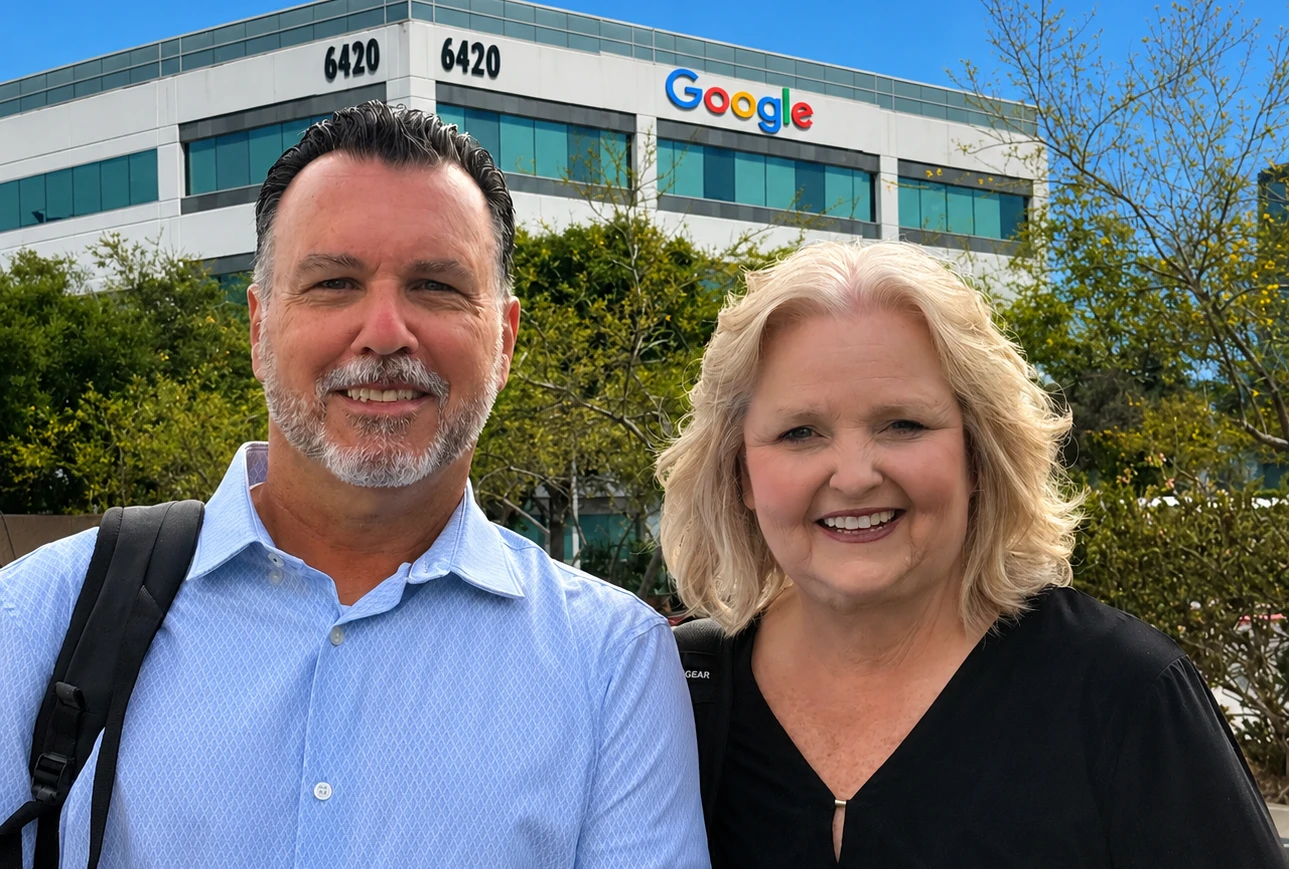
Last week at Google’s San Diego campus, a select group of executives gathered at a critical point in the industry’s evolution. The by-invitation-only meeting brought together Google executives, LocalIQ representatives, and key executives from across the country, including Cotton & Company’s President Laurie Andrews and AI Integration Director Dennis Von Aldenbruck. This forward-looking conversation focused on how search, advertising technology, website infrastructure, content, data, YouTube, voice tools, and AI discovery are being rebuilt around a new model of digital behavior.
This was a high-level discussion about where discovery is going, how quickly AI is being embedded into the way people request and receive information, and why the website has become one of the most important structural assets in the next phase of strategic marketing.
For Cotton & Company’s clients including developers, capital partners, country club leaders, and sales-driven real estate organizations, the implications are significant. The question is no longer whether keyword optimization alone creates online visibility. The question is whether the website is structured to be understood, trusted, surfaced, and recognized by the new AI-driven discovery environment.
Cotton & Company’s participation in the meeting matters because the firm was not entering the conversation lightly. The firm has been at the forefront of advancing AI visibility, website restructuring, first-party data thinking, search evolution, and digital discovery strategy across its real estate marketing network. The meeting reinforced that many of the strategic changes Cotton & Company has been implementing for months anticipated Google’s evolving AI direction.
“The Google discussions reinforced something we’ve been seeing for months. AI isn’t changing how people discover information in the future—it’s already changing how they discover it today. Our responsibility is making sure our clients are prepared before the rest of the market catches up,” said Laurie Andrews, President of Cotton & Company.
The Search Model Is Moving Beyond Keywords
For years, real estate digital strategy was built around familiar search behavior. A prospect entered a search phrase, and the platform returned results. A campaign captured interest. A website served as the destination. That model is being rebuilt based on evolving consumer behavior.
One of the takeaways from the Google meeting was the confirmation that people are expanding their use of online search tools, asking for information in a different way. They are using deeper prompts. They are searching by situation. They are giving platforms more context about who they are, what they need, and what type of outcome they are trying to evaluate.
That matters because AI discovery does not interpret interest the same way traditional keyword search did. It is looking for meaning, relationships, authority, usefulness, and context. A prospect is no longer searching only for a defined real estate community type in a specific geographic location. The questions are broader, more human, and more specific at the same time. They require a different kind of digital foundation.
One statistic magnified the pace of the shift in technology. During the meeting, Google underscored the pace of change: 99% of people interacting online used AI technology, while only 36% realized they were doing so.
Dennis Von Aldenbruck, Cotton & Company’s AI Integration Director, said the shift requires organizations to rethink how every digital asset works together. “We’re well beyond optimizing websites for search engines. Today we’re building digital ecosystems that AI can understand, trust, and recommend. That requires a completely different way of thinking about websites, content, authority and data,” Von Aldenbruck explained.
That is the new reality executives need to understand. AI discovery is already influencing how people move through information, even when they do not call it AI.
The Website Is Becoming the Fuel Source
The most important takeaway for real estate leaders may be this: the website is no longer just the place a prospect lands after a search. It is becoming one of the primary sources AI uses to understand whether a company, community, club, or development should be discovered. That reframes the role of the website completely and instills a sense of urgency in updating the current structure.
A website can still present a highly branded and compelling marketing presentation. It can still contain strong photography, clear calls to action, and inspiring copy. But if its structure is still built around older search assumptions, it is not prepared for the new discovery environment.
AI discovery requires a deeper foundation. It depends on content that answers the way prospects now ask questions, a structure that helps platforms understand relationships between location, lifestyle and buyer intent, and page architecture that reduces friction while supporting discovery.
For many organizations, this may require structural redirects, structural rebuilds, and a new approach to content development. It may also require a competitive gap analysis to understand whether the existing website is meeting the needs of AI-influenced discovery. That analysis should look beyond surface-level SEO. It should evaluate whether the site is structured to support search, AI discovery, voice tools, audio search, customer usability, and the changing way people request information.
The website now supports nearly every component of modern digital strategy—from visibility and paid media to first-party data and AI interpretation. In the new environment, the website is fuel.
Discovery Is Expanding Across Voice, Audio, and YouTube
The search bar is no longer the only doorway into discovery. Voice tools and audio search are changing the way people request information. Customers are no longer trained only to type fragmented phrases into a search field. They ask fuller questions. They speak in natural language. They expect information to be easy to access, easy to understand, and relevant to the situation they have described.
That change affects how websites are evaluated. If the content is thin, disconnected, overly generic, or difficult to navigate, it may not provide the clarity these systems need. If the structure does not reflect the way real prospects ask questions, the brand may be less visible in the moments that matter.
YouTube is also taking on a larger role.
Once viewed primarily as a video hosting platform, YouTube has become a major streaming television mechanism across households. Its role inside Google’s ecosystem makes it increasingly important as both a content platform and a source of behavioral understanding.
For real estate organizations, this changes the strategic value of video. A community overview, executive interview, club lifestyle feature, model residence tour, market explanation, or development update may do more than support a campaign. It may become part of a broader discovery framework that helps platforms understand relevance, authority, and audience intent.
That does not mean every organization needs more video for the sake of more video. It means video, website content, search strategy, metadata, paid media, and audience signals need to work together with more discipline.
The same principle applies to audio and voice. As information requests become more conversational, content must be prepared to answer real questions with structure, clarity, and authority.
Ad Technology Is Being Rebuilt Around Better Signals
The Google meeting also addressed one of the most important challenges in modern digital marketing: the loss of tracking visibility caused by cookie restrictions, pixel limitations, and reduced third-party data.
Google discussed server-side platform gateway concepts designed to help place pixels on individual project websites and capture activity as first-party data. For real estate organizations, this is a critical shift. Development marketing depends on understanding long buyer journeys, complex decision paths, and the difference between casual traffic and meaningful intent.
First-party data matters because it helps reopen the door to understanding and tracking in a more privacy-conscious environment. It also reinforces why website infrastructure has become so important. If the website is the place where meaningful behavior occurs, then the way that behavior is captured, structured, protected, and interpreted affects the performance of the entire marketing program.
LocalIQ’s XMO platform added another layer to the conversation. The platform was introduced as a cross-media optimization technology designed to help executives better understand performance across multiple channels, deploy advertising budgets more effectively, diversify audience reach, and take advantage of look-alike audiences and deeper content signals.
This is where the restructuring of ad technology becomes part of the larger AI discovery conversation.
Search, paid media, YouTube, website behavior, first-party data, voice signals, audio search, and audience modeling are becoming more connected. Campaigns cannot be treated as isolated tactics. Content cannot be developed separately from media strategy. Websites cannot be viewed as static destinations.
The organizations that will benefit are the ones that understand the system.

The Executive Challenge Has Changed
Can AI understand what the website is about? Does the content answer the way prospects now ask questions? Is the site structured around authority, context, and usability? Are redirects, page hierarchy, and content pathways helping discovery or creating friction?
Does the organization have a first-party data strategy? Is YouTube treated as part of the discovery system? Are voice and audio search changing what information should be easier to access? Has the competitive set been evaluated for AI discovery readiness?
The organizations that prepare their digital infrastructure today will be far better positioned as AI increasingly becomes the first point of discovery. For Cotton & Company, that transition is already underway.
Cotton & Company is already helping real estate organizations adapt to this transition, working directly with the platforms, technologies and strategies shaping AI discovery. For developers, capital partners and club leaders, the next step is evaluating whether their own digital infrastructure is ready.
“The companies that wait until AI discovery becomes obvious to everyone else will already be behind,” Andrews said. “The organizations that prepare today will be the ones AI recognizes tomorrow.
To begin that conversation, contact Cotton & Company at CottonCo.com, or reach out to Laurie Andrews directly at Laurie.Andrews@Cottonco.com