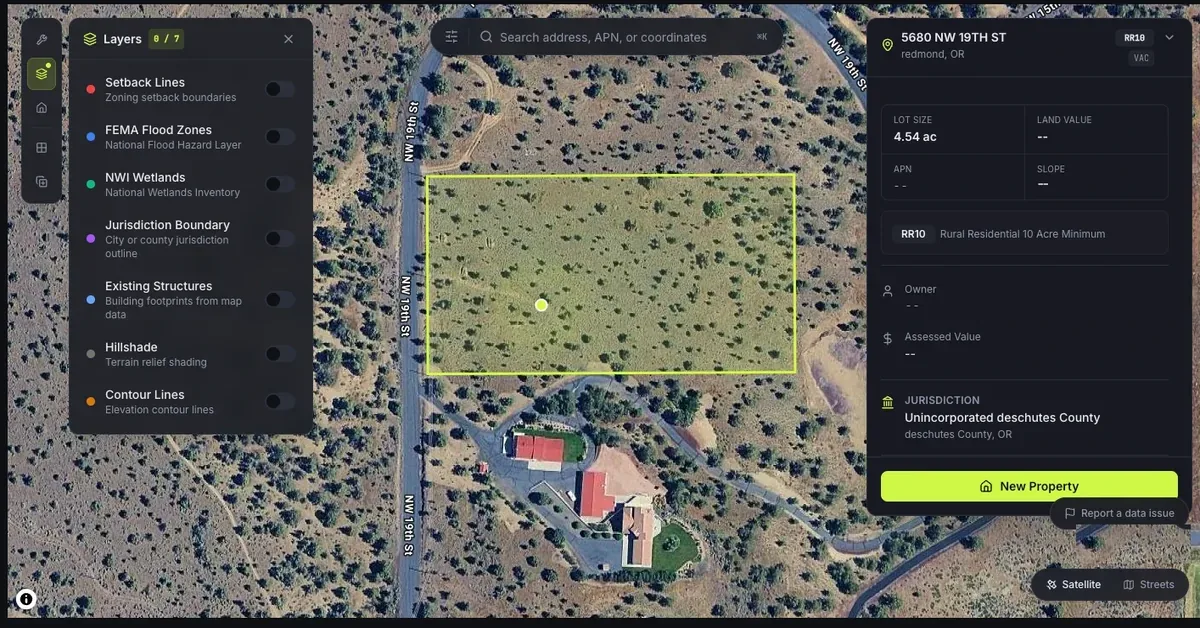
New property-intelligence tools are bringing zoning, floodplain, wetlands, slope, access and setback information into earlier stages of site evaluation.
Long before construction begins, a property can already contain the conditions that will shape cost, schedule, design and buyer confidence. Zoning, floodplain exposure, wetlands, access, slope, utilities and setbacks may all influence what can actually be built – yet that information has traditionally been scattered across different sources, departments and specialists.
For homebuilders, developers and sales teams, the challenge is not simply getting more data. It is getting the right context early enough to change a decision before a project is committed.
At Cotton & Company, real estate is at the core of everything we do. That means paying attention not only to how properties are marketed, but also to the operational, data and technology shifts changing how projects are evaluated, sold and experienced by buyers. For our clients, those shifts matter because they influence the questions buyers ask, the expectations sales teams set and the confidence a project can support.
A recent conversation with Don Healy, founder of SiteFacts, offered one example of how this trend is taking shape in homebuilding. SiteFacts combines property data, mapping, due-diligence workflows and AI-assisted processing to move more site intelligence toward the front of the process. The platform itself is one example; the broader trend is the more important story.
The Problem Often Appears Before the Build
In on-your-lot homebuilding, customers often arrive with a property they already own or are preparing to purchase. By the time a builder becomes deeply involved, assumptions may already have been made about what the lot can support, how much site work will cost and how quickly construction can begin.
Don saw the consequences of that firsthand while working for an on-your-lot builder producing roughly 170 to 200 homes a year. Property issues that had not been identified earlier would surface during permitting or construction, when contracts, financing and customer expectations were already much harder to adjust.
Moving due diligence earlier improved more than the site evaluation itself. It gave sales teams better information, helped set expectations sooner and reduced friction downstream in permitting, operations and construction.
That pattern becomes more important as builders grow. Don identified roughly 20 to 30 homes a year as a point where informal knowledge becomes harder to carry through the organization. A salesperson may know the customer but not have years of land-evaluation experience. A superintendent may have that experience but not the time to investigate every new property. The business begins to need systems that can help specialized knowledge reach the right decision earlier.
Property Risk Is Often Invisible From the Listing
Acreage and parcel boundaries can create a sense of certainty that the site itself does not support. The usable building area may be reduced by wetlands, floodplain, easements, setbacks, access constraints, slope or utility requirements. A property can look straightforward on a map and still carry conditions that materially change the economics or design of a project.
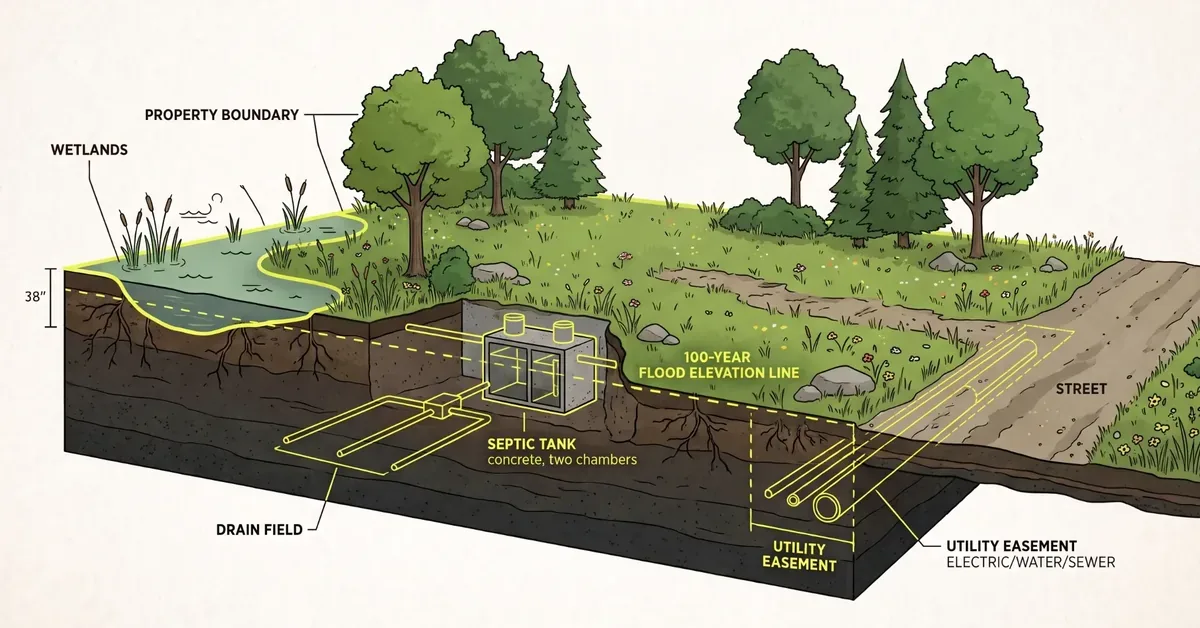
Acreage alone does not define buildability. Wetlands, flood elevation, easements, utilities and septic conditions can reshape the usable area of a parcel.
This is where experience still matters. After enough years walking sites and building homes, professionals develop pattern recognition: a lot that has remained undeveloped while everything around it was built, an unusual access condition, a slope that looks minor but changes site-work costs, or a zoning designation that deserves another question.
“We’re trying to scale that builder’s eye – that gut feeling you develop after walking and building enough properties. Little red flags start adding up, and you know there’s something there.”
The important shift is not replacing that instinct with a score or checklist. It is using better property intelligence to help more people know when the instinct should be applied.
A New Layer of Tools Is Moving Due Diligence Upstream
The tools emerging around homebuilding are beginning to consolidate information that previously required multiple searches, calls and handoffs. Mapping layers can surface floodplain, wetlands, slope, jurisdiction and setback information. Buildability views can bring several conditions into one early read. Deeper reports can then move the investigation into utilities, title, easements, regulations and other property-specific issues.
SiteFacts is one example of this shift. Its workflow moves from an early property view into a Site Score and then, when a project advances, into deeper due diligence. The point is not that one platform makes a property decision for the builder. It is that increasingly sophisticated tools can organize the questions earlier, before the project is farther down the sales or construction path.
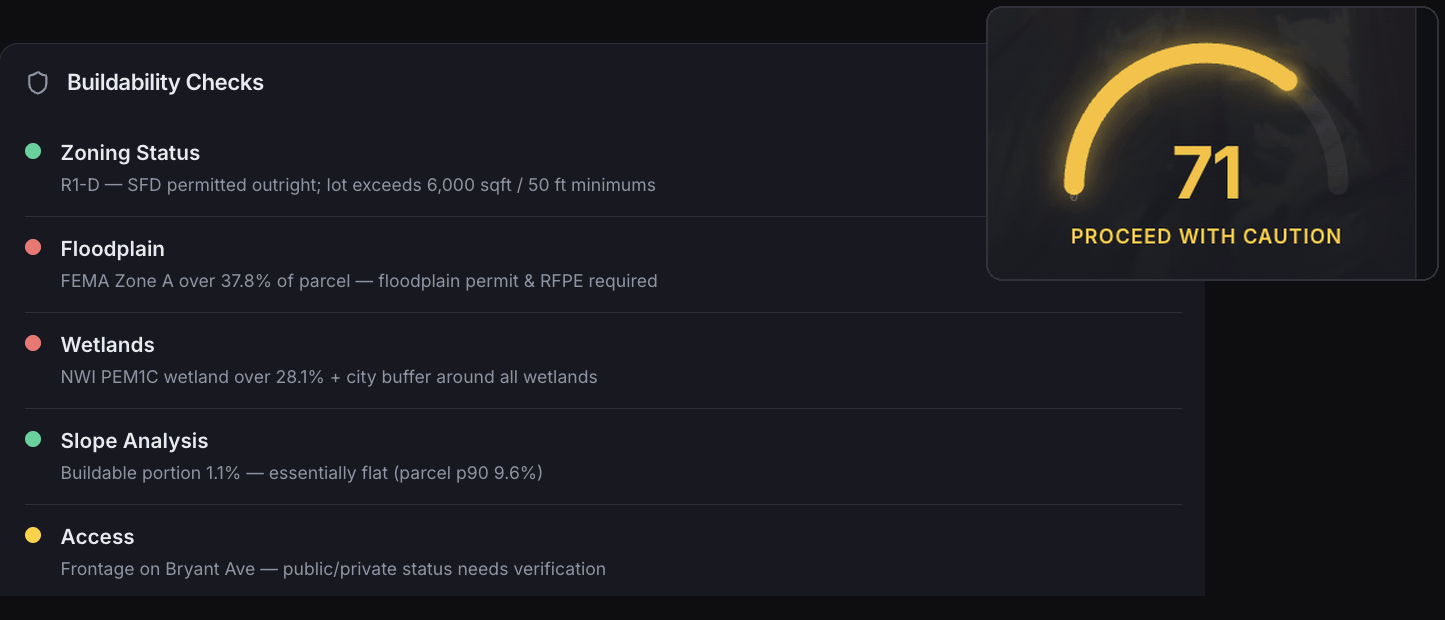
A consolidated buildability view can surface multiple site conditions before a project moves deeper into planning, sales or construction.
That distinction is especially important in real estate, where the same condition can mean different things depending on budget, design intent, market positioning or risk tolerance. A useful system should improve the decision process without pretending that context no longer matters.
AI Is Becoming Part of the Workflow, Not the Whole Story
Artificial intelligence is one of the technologies making these systems faster and more scalable, but the most credible applications in homebuilding are not necessarily the ones trying to remove people from the process. They are often the ones helping experienced teams process more information, recognize patterns sooner and move routine work more efficiently.
“Construction is a high-trust industry. People would rather endure a little pain with a process they know than go through the process of onboarding a new technology.”
That trust barrier helps explain why adoption can be slower in construction than in sectors where a software error is easier to reverse. A mistake in a construction workflow can become a permitting delay, added cost, customer issue or field problem. New technology has to earn its place by improving accuracy, efficiency or communication in ways a team can see.
“AI is much more useful as an amplifier for expertise. The conversation isn’t about replacing people with technology; it’s about helping the people you’ve already invested in do more, work more efficiently and extend their expertise further.”
In practice, that can mean helping a permitting specialist handle more volume, shortening estimating cycles, organizing property research or giving a sales team earlier access to site information. The technology is valuable because it extends expertise – not because it makes expertise unnecessary.
Human Validation Still Matters When the Data Has Consequences
SiteFacts also illustrates another pattern we expect to remain important as AI becomes more deeply integrated into real estate workflows: human validation. The company uses AI and data systems to collect, refine and organize property information, while keeping human review in its reporting process.
“We use AI to scale, refine and magnify the data we’re collecting, but the reports are still human validated. I don’t see a day where we completely take our hands off the wheel. It’s about leveraging technology to make us more efficient and accurate, and compounding that with human expertise.”
That is not a limitation of the technology. In many real estate applications, it may be the appropriate design. Regulations can contain local nuance. A buyer’s budget can change what constitutes an acceptable site condition. A planning question can produce a very different answer depending on how much context is brought into the conversation.
The better model is often decision support: organize the information, identify what deserves attention and make the human conversation more informed.
Better Property Intelligence Changes More Than Due Diligence
When information moves earlier, its impact extends beyond the person evaluating the site. Sales can set expectations with more confidence. Estimating can recognize site-related costs sooner. Permitting teams can begin with better questions. Customers can understand why a property may require additional steps before those steps feel like surprises.
The same principle applies to the handoff from customer intent to design and construction. One SiteFacts feature allows a floor plan to be placed within a parcel view so the customer and builder can discuss orientation, setbacks and siting before that information moves downstream. It addresses a deceptively simple problem: translating what a customer sees on a piece of land into something another team can reliably act on.
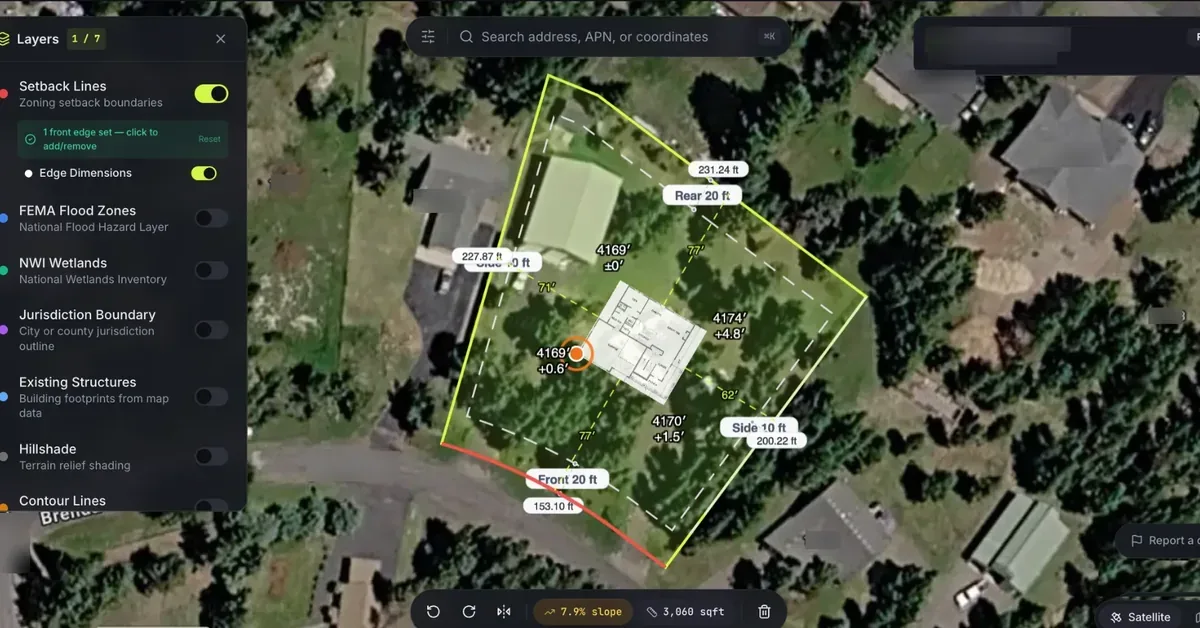
Site planning tools can help teams discuss home placement, setbacks and orientation before information moves downstream to design and construction.
For builders, the value is operational. For buyers, the value is clarity. And for sales and marketing teams, the value is a more accurate foundation for the promises, timelines and stories being communicated around a project.
Why This Matters to the Broader Real Estate Industry
The homebuilding example is part of a larger shift across real estate: important intelligence is moving closer to the beginning of the decision. Data that once sat in separate systems is becoming easier to layer together. AI is making some of that information faster to process. Experienced professionals are gaining tools that allow their judgment to travel farther across an organization.
For developers and builders, that can improve how land and project risk are evaluated. For brokers and sales teams, it can improve the quality of the information brought into buyer conversations. For marketers, it creates a better understanding of what the product actually is, which constraints are material and which proof points can support confidence.
That is why these tools are relevant to our clients at Cotton & Company. Real estate marketing does not operate in isolation from the development and sales process. The more accurately a team understands the property, the project and the buyer’s likely questions, the more effectively positioning and communication can support the business rather than compensate for information that arrived too late.
What We Are Watching Next
Don expects a new generation of builders to incorporate modern technology from the beginning rather than layering it onto legacy processes later. He describes them as “AI-native builders”: smaller, well-networked teams using technology across customer service, sales, estimating, scheduling and preconstruction while the physical work of building remains fundamentally human.
“I think we’re going to see a rise of AI-native builders – companies starting with small teams, well-networked and leveraging technology from the beginning.”
Whether that exact model becomes common remains to be seen. The broader direction is already worth watching: the competitive advantage is shifting away from simply having access to data or AI and toward knowing how to combine technology with specialized knowledge, strong processes and human judgment.
For real estate companies, the question is not whether every new tool deserves adoption. It is whether a tool helps critical information arrive earlier, improves the quality of a decision and gives the people closest to the work more leverage over what they already know.
That is the trend worth following – because when better information reaches the process sooner, it can influence everything that follows.
Don Healy quotations have been lightly edited for clarity and brevity from Cotton & Company’s September 2026 conversation with the SiteFacts founder.