
By Sonya Pereira, Director of Web Development, Cotton & Company
AI can make it easier to build, test and automate. The harder question is whether the work deserves to be scaled, trusted or inserted into a live business process at all.
That was the question I kept coming back to during Day Zero of The AI Conference in San Francisco, where I moved through four workshops on enterprise investment, product development, leadership and local multimodal AI.
Day Zero was intentionally small: 350 participants, eight 90-minute workshops and two tracks focused on technical execution and leadership. The main conference opens to more than 5,500 attendees, but this first day was built for working sessions – the kind where an idea has to survive questions about cost, adoption, governance and implementation.
By the end of the day, the four sessions had covered four separate decisions: what deserves investment, what needs validation before more money is spent, what a leader should never delegate, and where the underlying intelligence should actually run.
None of the sessions made a convincing case for adopting AI because it was new. The useful conversations were about evidence: what problem is being solved, what changes if the system works, and what would justify taking it further.
That is especially relevant in real estate development, where marketing operates inside a long-cycle, capital-intensive business. Technology earns its place when it helps us read buyer behavior sooner, test a position before the market makes the decision for us, improve execution or protect capital. If it cannot improve the work in a way we can identify and measure, it is simply another layer to manage.
A Demo Has to Earn the Right to Scale
The first session was led by Evangelos Simoudis, co-founder and managing partner of Synapse Partners. He has spent more than 35 years in Silicon Valley as a venture investor, entrepreneur, corporate executive and technologist, including roles at IBM, Apax Partners and Trident Capital. His workshop treated AI as an investment decision rather than a technology showcase.
The exercise was direct: evaluate the opportunities, decide what to build, buy or partner for, and identify where to invest, where to wait and what to stop. A prototype proves that something can be built. A pilot begins to show whether people will use it and whether the economics make sense. Scale is a different threshold altogether because the system has to work inside the business, not just in a presentation.
Simoudis treated AI initiatives the way an investor would treat a portfolio. Funding is not permanent. A project keeps earning investment only while the evidence supports it. That discipline matters when teams have already invested time, political capital and budget into an idea that looked promising at the start.
AI is unusually easy to demo and unusually easy to overvalue. A polished proof of concept can feel finished long before the hard questions have been answered: Who will use it? What data does it depend on? What does it cost to operate? Where does it fit into the workflow? What improves if it succeeds?
The same standard belongs in marketing. A research workflow should improve the quality or speed of insight. A content system should produce accurate, relevant work that supports discovery and conversion. An analytics layer should help the team recognize a buyer or sales signal sooner. The metric belongs to the business problem, not to the presence of the automation.
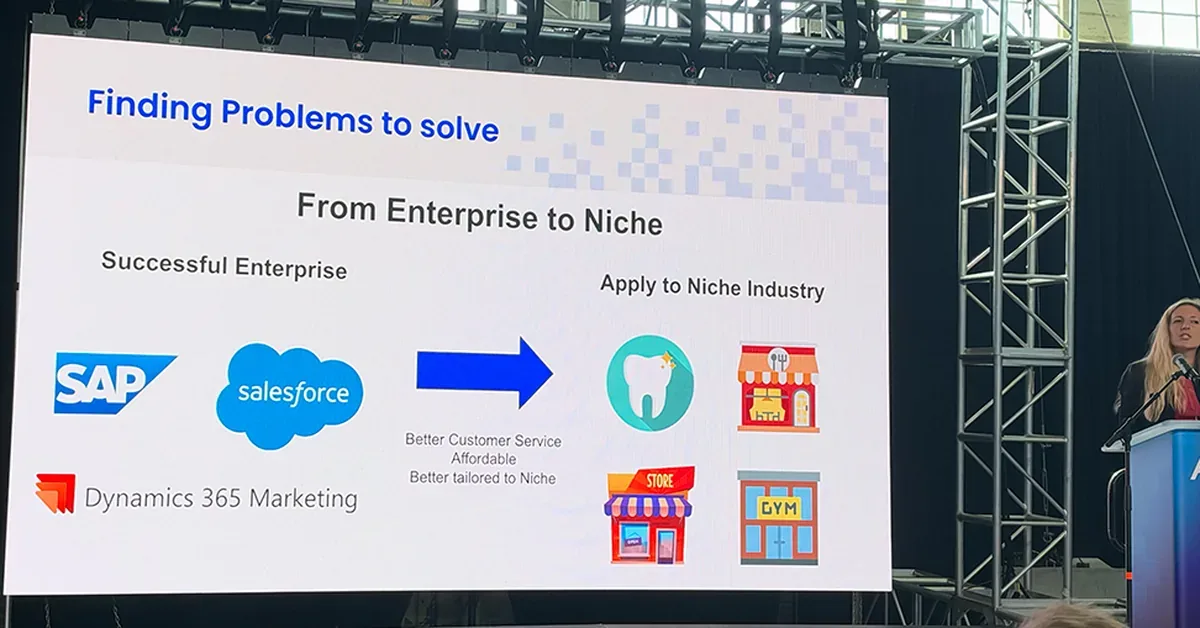
A Day Zero workshop on identifying problems worth solving | The AI Conference, San Francisco
Faster Prototyping Raises the Cost of Getting the Problem Wrong
Dr. Marily Nika, founder and CEO of AI Product Academy and an AI product lead at Google, moved the discussion from investment to product creation. Her starting point was simple: identify a problem worth solving before building around the technology.
The workshop moved through demand validation, product requirements, design, rapid prototyping and evaluation. AI-assisted research was paired with real user conversations. Requirements were translated into a focused product brief. AI agents could then take on customer, product, engineering and risk perspectives to challenge assumptions around scope, feasibility, privacy, customer value and overpromising before a team committed to a direction.
The practical advantage was speed. An idea that once lived in a planning document can become a working prototype early enough for clients, colleagues or users to react to something tangible. That is valuable because it moves feedback forward, before a team has committed months of work to the wrong direction.
That same speed makes weak assumptions more expensive if no one stops to test them. Nika separated the prototype from the MVP: one gathers evidence; the other tests desirability, feasibility, business viability and the riskiest assumptions. Her session also emphasized evaluation for relevance, groundedness, completeness, safety and hallucination risk. Faster production only helps when the validation gets faster too.
For real estate marketing, that opens a useful window. Website experiences, research tools, content systems and internal workflows can be tested much earlier. The advantage is not volume. It is the ability to find out sooner whether the idea solves a real problem, whether the information is accurate, and whether the experience helps a buyer, sales team or client make a better decision.
That is also how we think about the Cotton Insights Engine. Data does not become intelligence because more of it was collected. It becomes useful when buyer behavior, sales feedback, media performance and market conditions are interpreted together and someone can explain what deserves attention.

Mo Fong leads a Day Zero workshop on AI-powered leadership and strategic decision-making | The AI Conference
Leadership Still Owns the Call
Mo Fong, executive coach and adjunct lecturer at Stanford University, focused on the part of AI adoption that is easiest to lose sight of: the leader still owns the decision. Fong spent 15 years at Google in senior roles across technology, operations and people, including serving as Chief Compliance Officer for Google Payments.
Her session used decision science and critical-thinking exercises to show where AI can be useful before a decision is made. It can reframe the problem, surface options, challenge assumptions, organize research and pressure-test a position. What it cannot do is absorb the consequences of the choice.
One practical method was the BUILD framework: Background, Underlying goal, Identity, Limitations and Desired outcome. Before asking AI for an answer, the framework asks the leader to define the situation, clarify the objective, establish the role AI should play, identify constraints and describe what a useful outcome actually looks like.
Several exercises were designed to make the decision harder before making it easier: generate another option, look for evidence that disproves the favored answer, test the assumptions, and consider the longer-term consequences. That is a better use of AI than treating the first confident answer as a recommendation.
In real estate marketing, that matters because the data rarely points to one clean explanation. If a campaign is underperforming, the problem could be pricing resistance, product-market fit, timing, lead quality, creative, media allocation, sales follow-up or a wider change in buyer confidence. AI can organize those possibilities and help test them against the available evidence. It still takes market context and experienced interpretation to decide what is actually happening.
Fong’s point was less about handing work to AI than improving the quality of thinking before the call is made. A system can surface a blind spot or organize the evidence. The leader still has to listen, make the trade-off, communicate the decision and own the result.
That is consistent with Cotton’s point of view on AI: use the technology to strengthen interpretation and execution, while keeping accountability with the people who understand the market, the client and the sales reality.
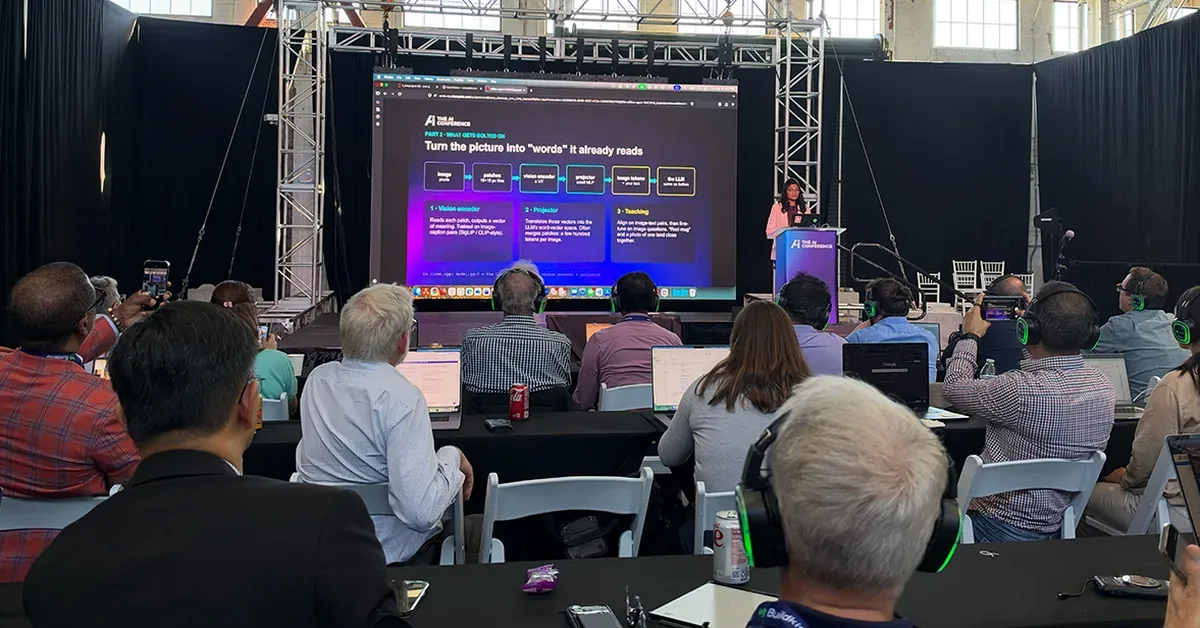
Kavya Sri Chennoju demonstrates local multimodal AI during Day Zero | The AI Conference
Where the Model Runs Is Now a Business Decision
The final workshop, led by Kavya Sri Chennoju, Staff AI Engineer at Arm, moved deeper into the technical architecture behind AI systems. Chennoju works on AI infrastructure and tools that connect agents to edge devices; before Arm, she spent five years at Amazon working on production vision and multimodal AI systems.
This was a live build, not a conceptual demonstration. The system used camera input and voice commands, ran inference through a local multimodal model and returned responses without depending on an external cloud API. The model could see and hear what was happening in the room while the processing stayed on the device.
That makes infrastructure part of the business decision. Local processing can make sense when data needs to stay in place, connectivity is unreliable, latency matters or the application requires tighter control. Cloud systems bring their own advantages. The right answer depends on the use case, the data, the performance requirement and the operating environment.
For organizations working with first-party analytics, CRM data, websites, content libraries and client information, those choices are not buried in the IT department. Where information lives, what can access it, what is automated and how permissions are managed all affect how safely and effectively AI can be used. Architecture and governance are now part of the marketing operating model.
Four Workshops, One Operating Standard
The common thread was discipline. Decide whether the problem deserves investment. Validate the need before scaling the solution. Use AI to challenge the thinking without handing over accountability. Then build the technical environment around the real use case and data requirements.
That lines up closely with the way Cotton is building an intelligence-led approach to real estate marketing. The Cotton Insights Engine connects buyer behavior, sales performance, market intelligence, media, search and AI visibility so that the team can identify which signals deserve action – not simply produce more reporting.
The same discipline applies to AI visibility for real estate development. As buyers use AI-generated answers and comparisons earlier in the discovery process, a project needs clear, credible and consistent information across its digital ecosystem. Technology can reveal gaps and accelerate the work. The market position and evidence still have to be real.
For us, the standard is simple: more content, more data, more agents and more automation do not automatically create better marketing. Better means the work becomes clearer, more relevant, more measurable or more useful to the sales objective. That is the threshold the technology has to meet.
What We Are Bringing Back to Cotton
I left Day Zero less interested in any single model than in the operating questions behind it. What problem is worth solving? What is the smallest useful test? What evidence earns the right to scale? Which parts of the work need to remain human-led? What does the data and technical environment require?
Those questions are more useful to me than a list of new tools because they give us a way to evaluate what is worth bringing back to Cotton. The technology can change quickly. The standard for whether it improves the work should not.
At Cotton, that standard is already shaping how we approach research, content, market intelligence, web development and AI-driven discovery. We are not looking for an AI layer to add to every process. We are looking for the places where it improves clarity, speed, visibility or decision quality – and where that improvement can be validated against an actual business outcome.
An experiment that saves no time, improves no decision and changes no measurable outcome has not earned the right to scale. The same applies to content systems, research tools, analytics layers and agents. The burden of proof should rise as the system moves closer to the client, the buyer or a live business decision.
That is the filter I am carrying into the rest of the conference: show me where the technology makes the work better, show me the evidence, and be clear about where human judgment still has to carry the responsibility.