
Somewhere in your analytics right now, there is a gap you cannot see. A prospective client researched your firm, compared you against three competitors and formed a preference. They never visited your website. They never clicked an ad. They asked an AI assistant what it knew, and the answer they received shaped their shortlist before you had any opportunity to influence it.
This is no longer a distant possibility. Buyers of residential real estate developments, and the developers, capital partners and club leaders who market them, are discovering that a growing share of the research process now happens inside AI-generated answers. The impact is beginning to show up in the numbers, and marketing teams are starting to understand that this is not a long-term problem to monitor. It is a short-term problem to address, quickly and strategically.
Most teams respond the way experienced teams usually do: they roll up their sleeves and tackle it themselves. That instinct is admirable, and it is also where most organizations underestimate the assignment. Maximizing AI visibility is not a tool you install or a channel you add. It is a strategically designed ecosystem.
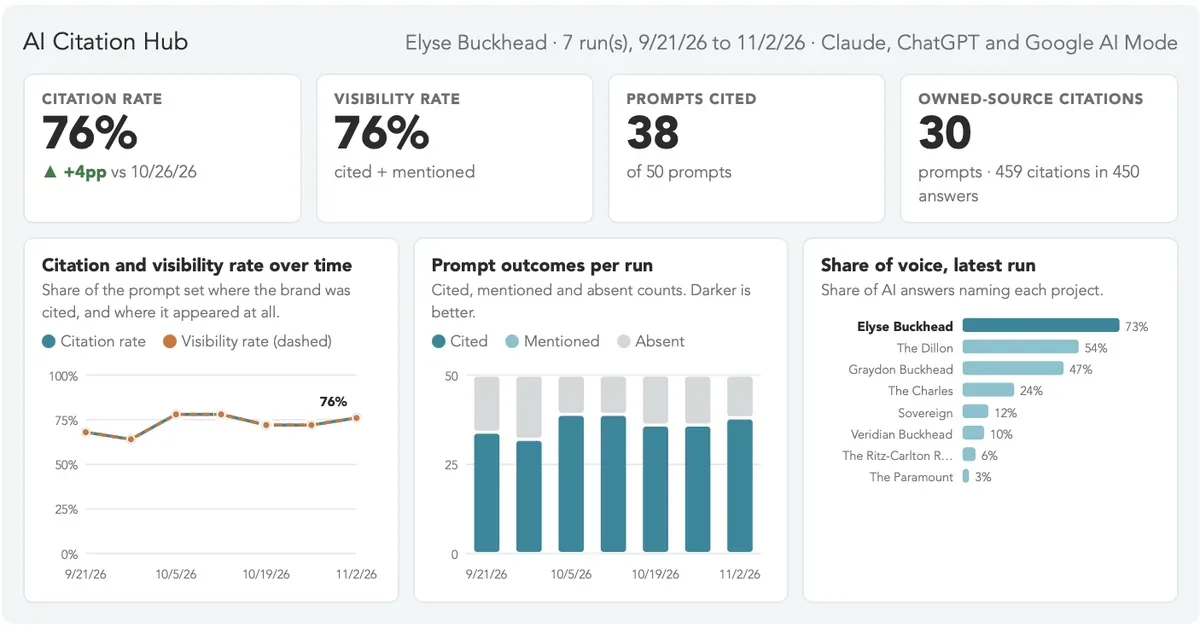
Elyse Buckhead — AI Citation Hub measuring citations, visibility and share of voice.
Start With Measurement, Because Google Cannot Show You This
Before any tactic, understand what you are measuring and why. For two decades, search rankings, traffic and conversions have defined how marketing teams evaluate visibility. Those measures still matter. But AI discovery does not happen inside Google’s reporting, and Google is not evaluating the larger landscape of platforms where your reputation actually lives. Traditional analytics still matter, but they cannot show you the complete picture of how your organization is being represented across independent AI platforms.
A buyer can ask an assistant about your firm, your development or your market and receive an answer drawn from across the open internet, with no data point ever reaching your dashboard. That means measurement begins with understanding your citations, your mentions and, most importantly, your absences.
Where are you being referenced in AI responses? What sources are those systems drawing on? Where are your competitors appearing and you are not? An organization that cannot answer those questions is optimizing blind, and optimizing blind is how good teams waste a year on tactics that never reach the systems shaping buyer decisions.
Audit Your Foundation Beyond SEO
The first structural task is a web audit, but not the kind most teams run. Traditional SEO audits evaluate whether search engines can crawl, index and rank your pages. The question now is broader: when an AI system evaluates your organization, does your site give it what it needs to understand, substantiate and trust what you claim?
That requires accounting for answer engine optimization (AEO) and generative engine optimization (GEO) alongside search.
In practical terms, it means evaluating whether your site’s structure answers the actual questions your buyers ask, not just whether it targets the phrases they type.
For many organizations, this surfaces specific gaps: cluster pages that connect related topics into a coherent body of evidence, and FAQ content that directly answers the questions an AI system is asked at the moment of recommendation. If your foundational structure was built entirely for search rankings, it was built for a smaller version of the job.
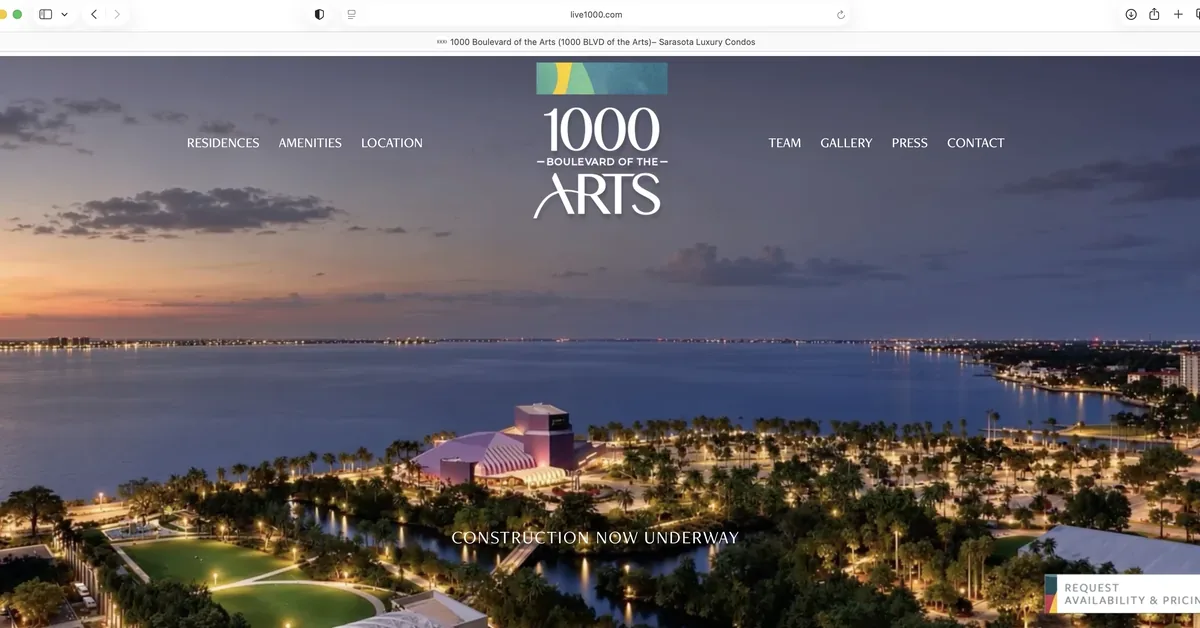
1000 Boulevard of the Arts — Sarasota condominium website.
Optimize the Ecosystem, Not Just the Website
Your website is one source among many that AI systems consult. They draw on your social profiles, your YouTube channel, your Google Business Profile, review platforms and the wider web of public information about your organization. A buyer’s impression of your firm is assembled across all of them.
Each of these properties needs to be optimized for visibility on its own terms, and they need to be interconnected. A YouTube channel with strong, specific content becomes a citable source of expertise. A maintained Google Business Profile confirms your legitimacy and location. Social profiles that carry real substance, rather than recycled announcements, teach the systems what your organization is known for. When these signals are consistent and connected, they reinforce one another. When they are inconsistent or neglected, they dilute everything your website is trying to say.
Build Authority Through the Partners You Already Have
Here is where many organizations leave real value on the table. You have a landscape of partners, collaborators and industry relationships already in place. Many of these partners have established credibility of their own, and their public acknowledgment of your work can provide independent evidence of your experience.
Look at who you are working with and how you are networking with them. Are your partnerships visible online in ways that systems can discover? Do the architects, land planners, technology partners, interior designers and industry professionals you work with mention the relationship in their own content? When a capital partner or respected industry voice acknowledges your work, that acknowledgment becomes part of the evidence base AI systems draw on.
Building authority does not always mean creating something new. Sometimes it means activating the credibility of the people you already work with, deliberately and visibly.

VIZI Authority — visualizing content strategy, production and distribution.
Put Your Storytelling and Leadership Into the Program
AI systems are looking for organizations that demonstrably know what they are talking about, and they evaluate expertise through evidence: the articles you publish, what you post, the professional groups where you participate, and whether your leadership team is visibly integrated into the program.
This is where self-directed efforts most often stall. A company publishes a few articles, an executive posts twice, and the effort fades because nobody owns it strategically. A complete program treats storytelling as an ongoing discipline: editorial content grounded in what your organization is genuinely qualified to claim, participation where your actual buyers and peers are listening, and leadership whose perspective appears consistently enough to become recognizable expertise. When leadership is integrated into the program rather than appended to it, the organization’s authority compounds instead of stalling.
Look at Where Your Content Is Actually Being Picked Up
Distribution is the multiplier on everything above. An article that sits on your blog is one signal. That same article picked up by a trade publication, referenced by an industry group or cited in someone else’s research becomes several signals in places AI systems weigh heavily.
Audit your distribution mechanisms honestly. Where is your content being picked up now? Where could it be? Which outlets, platforms and communities in your market actually influence the recommendations buyers receive? Then treat distribution as a designed part of the strategy rather than an afterthought, because reach in the right places is what turns good content into visible authority.
Close the Loop
Notice that measurement is where this began and where it ends. The audit tells you where you stand. The tactics move you. Measurement tells you whether it worked, where you are being cited, where you are still absent, and where the next opportunity lies. An organization that runs this loop has a strategy. An organization that runs tactics without it is guessing.
This is the point where most teams attempting this on their own realize the size of what they have taken on. The six tasks operate as one connected system, and the organizations that fill the gaps first have a distinct advantage.
“People are recognizing that AI is affecting their numbers, and their instinct is to fix it quickly with a few tactics,” says Laurie Andrews, President of Cotton & Company. “What they are often not seeing is that the challenge is strategic. AI visibility is essential to your website, your entire online ecosystem, your partnerships, your storytelling and your leadership. It all needs to be measured, monitored and utilized to direct your future marketing investment.”
That understanding is what Cotton & Company built into Vizi Authority™, an industry-leading platform integrating strategy, research, content development, distribution, measurement and future recommendations, designed to build the signals AI systems evaluate when they decide who to trust.
“The platform begins with strategy and evidence,” says Dennis Von Aldenbruck, Director of Technology for Cotton’s VIZI Authority™ system. “Every piece of content is connected to a strategic claim, distributed where it creates the strongest signals, and measured by how AI systems actually cite and recommend the organization. That connection is what turns visibility work into a system.”
For more than four decades, Cotton & Company has specialized exclusively in real estate development marketing, across more than 1,700 properties. Vizi Authority™ extends that strategic discipline into AI-driven discovery. To see how the platform evaluates your current authority and builds the path forward, visit viziauthority.com and request a demonstration or contact Cotton & Company to learn more.